Showing posts with label Levi's. Show all posts

Sunday, 26 February 2017

I'll be your mirror: LVC's lefty 1976 jeans


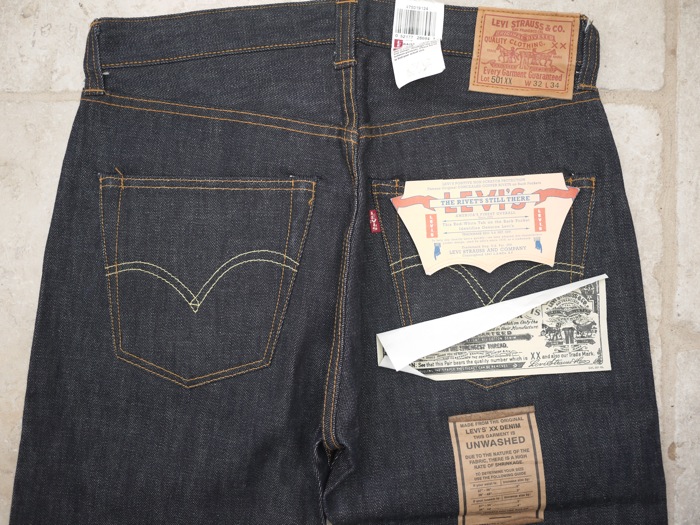
I'll update this post later, but I told friends I'd post photos of the pair of LVC 1976 mirror jeans that I was privileged to open in the mail recently.

The inspiration came when Cone Mills decided to put back into service an old G Series loom that was on display in their reception (I photographed the loom during my visit and will try and locate the photo soon). The loom still had a bolt of fabric, which it was weaving just before the venerable machine's retirement. Levi's staff were overjoyed and talked of making some jeans from the deadstock fabric - before realising it was a left-hand twill. Levi's 501 is famously right-hand twill. How could they turn from left to right? Easy! Make these mirror image jeans.

There are, I've been told, around a dozen pairs using the original fabric. I was lucky enough to be in the office around the time they came up with the idea. The kind, crazy people offered me a pair... and unlike so many people in the planet followed up on their promise. So these are one of a dozen or so pairs using the deadstock fabric.

It was strange for me to open up a pack with these jeans, as they are so strongly evocative of so many new pairs I've owned. They're a very authentic cut, as the pattern was taken from a deadstock pair of originals  - when taking a pattern from worn, washed jeans, more guestimates are obviously involved. There will be a limited edition of 501 mirror jeans, using fabric which replicates the original run. And the other good news is there will be a regular reissue of the right hand twill version, at a lower price. These are a very distinctive shape, high waisted, carrot shape - a cut which I reckon is very popular right now. Makes a great change from the usual 50s and 60s shapes, and it will be fascinating to see how all versions, using the deadstock and the repro fabric, look as they wear in.


The G series loom was used for training. Hence the deadstock fabric has loom errors, presumably from when it was set up to demonstrate how to configure a left hand twill. So actually, these are MOSTLY left hand twill!


Friday, 4 November 2016

A Revolutionary Appearance

Just a quick, late note to say I'll be speaking about denim and the Counterculture at the V&A this evening, Friday 4 November, in conversation with fashion historian Amber Butchart. We'll be discussing the years 1966-1970, as well as the roots of the counterculture, and how the story of denim is interwoven with that of music and art. It's free, and is scheduled for 19.30-20.30 in the Tapestry Room.

Monday, 30 June 2014

You've been rumbled! How to spot counterfeit Levi's part 2...

My post on How To Spot Counterfeit Levi's turns out to be one of the most popular items on this site.
Having informed customers doesn't seem to stem the flow of the dodgy denim, though.

Today someone alerted me to this pair on eBay. They have just about every warning sign indicated in my previous post; extra selvage, a dodgy, shiny, coffee-coloured leather patch, and some of my favourite spelling mistakes: don't rumble-dry these jeans! More subtle is the basic constructional error on the yoke, which differs across different Levi's… I've seen this error on some LVC jeans, too.

Thanks to the seller, madness79, for the entertainment. I've used their photos for the purposes of education - especially regarding spelling.


Thursday, 6 June 2013

Fantastic 1880s photo of a miner in a 3-pleat jacket


I just noticed this lovely photo that came through to my spam folder, sent to me by JDW. Thanks, JD! He writes," I found a photo held by the Library of Congress (USA) of miners taking a break after dinner at a mine in Atlanta, Idaho taken in the 1880s, and one gnarly miner appears to be wearing an iteration of the three pleat jacket. I found the picture to contain great character and thought that you might like to see it as well (if you haven't already)."

 The jacket indeed looks very similar to the Levi's 3-pleat - but for the higher pocket positioning, and the fact there appears to be just the one pocket. It's possible it could be made by Levi's nonetheless -  Levi's items were home-sewn, contracted out to individuals around San Francisco, and there are often significant constructional differences between similar models. One fascinating aspect of early workwear is that many designs were generic - was one manufacturer copying another, or were they all basing their designs on previous items?  So many makers were recent immigrants, these were quite possibly based on European originals.

Take a look at the original photo; I have written to the Library of Congress asking to reproduce it on this blog.

Sunday, 3 February 2013

Ducks, miners and secret agents: LVC preview, Spring/Summer 2013


A few years ago, the LVC range was suffering from a simple lack of TLC; there was inconsistent supply, and the clothing itself was often repetitive and occasionall uninspired. In the last few years, though, I think they've got their groove back. 

LVC's relatively new policy of supplying a much wider range of clothing has annoyed some diehards, principally because of the "reissue" of fictitious items such as, say, last season's Navy Smock - an item never produced by Levi's. In contrast, though, we've recently seen some of the most accurate, intriguing reissues of LVC's history, like last year's beautiful Triple-Pleat Blouse. I think this year's Spring Summer collection is every bit as intriguing, and I particularly love the emphasis on non-denim items. So, here's a quick run-through of what I reckon are some of the highlights. 

While I'm personally not a devotee of washed items, this range includes some shirts which I think take washed finishes to a new level. In particular, I loved this 1910s Pullover Sunset Gingham Shirt. 

Gingham was a hugely popular fabric in late 1800s USA -  it was also, incidentally, very popular in Japan. I don't know if this is a reissue of a specific shirt from the archives, somehow I doubt it, but it's a beautiful shirt which resonates with many vintage items I've looked at. The wash is one of the nicest I've seen on a repro shirt, and gives a great impression of being bleached by an unrelenting sun. 


Several items are straightforward reintroductions of items we've seen in previous LVC ranges, like this pair of Lot 66 1920s Bib Overalls. I'm not sure of the source of 2 by 1 denim; Cone have supplied similar fabrics to LVC in the past. These are quirky items with beautiful detailing, in particular the bib straps. It's good too see these back in a raw version. Click for a bigger version of the picture. 


One major new step for LVC is the reintroduction of the women's range. For a brief period around 2003, LVC produced some beautiful customised, womens' items - what we have here is in a similar vein, such as this pair of Koveralls, in a customised cut and finish, called Gravel Bank. 

Along the same lines is the women's cropped Type 1 jacket, with three quarter sleeves and a customised A line shape. 

This is a new wash, named Bodie, of the original XX or Nevada jean - once thought to be an alternate version of what became the 501, it's now believed to be the precursor, with more workwear-style detailing, such as the pliers pocket on the left hip, and more widely-spaced stitching on the back pocket. It's a good wash, although to my mind now quite up to the level of some of the landmark LVC by the (mysteriously disappeared) Bart Sights. 


The 1874 Closed-Top Cotton Duck Jumper was one of the most historically-significant recent LVC repros; this is a similar one-pocket version, which IIRC was at one point repro'd by Levi's Japan. This version uses a Cone 2x1 9oz denim in a distinctive wash (if you can call a process that makes fabric dirtier a wash). Like the duck version, this will be a baggy fit, good for layering over other shirts. 


I'm not certain of this, but I believe there is a revision to the details of the raw 1966 501. On the left is the rinsed version, on the right is the raw. The raw had a new arcuate shape, not as shallow of the old one, which to my mind exaggerated the flatness of the original. 1960s arcuates did vary widely in shape, as the tooling used to make them was worn, hence we can't say there's on definitive shape, but I find this one more convincing than the previous version. It's this 1966 jean, of course, which features Cone's evocation of the original slubbier 60s denim, caused by the Magnadraft process. 


New Rinses

In addition, I'm told there's a new, simpler wash to replace the old Rough Rinse. Rough Rinse 501 used Cone fabric but were sewn in Turkey, and given a tinted wash. The new version, Rough Rinse, applies to the 1947 and 1954, and loses the tinted wash - which is a big improvement. 


Other nice items; a White Tag pants and 507 jacket (note the absence of rivets), in a paler Sky Blue denim, a late '60s (or early 70s) Laundry Bag (with oversized pocket) and, going rather further back in time, a Shield Front Henley.


I'm told that 2012 was a high watermark year for LVC, partly due to the James Bond effect; Daniel Craig wore a Menlo jacket in Skyfall, which caused a massive spike in sales (as did Bond's wearing a beautiful pair of Crocket and Jones Islay). It appears that only recently did a Levi's employee notice that one Menlo jacket in their archives is actually fully reversible. Hence this new version.


Now for more of my personal favourites, followed by a quick peek at the fall look.

Anyone who follows this blog will know that I'm intrigued by Levi's early cotton duck items. The very first riveted pants ever made by Jacob Davis were sewn from white duck; and recent research has brought new insights into the fabric used on early Levi's duck items - the wide selvage line suggests the fabric was probably made for ship sails.

Now it appears that Levi's and Cone have developed a new shade of the tan cotton duck, to try and provide a better match to some early samples (it is of course impossible to be completely definitive about fabric colours, due to the ageing process). There is a Youth's Waist Overall in the Levi's archive in a more brick-coloured tan; a second variant of this fabric, it appears, was in a more mustard shade. This is used in a new version of the Single Pocket Duck Waist overalls. Note that this pair feature a double stitched yoke (some early examples had only single stitching or, in some examples, no yoke whatsoever). Note the wide selvage, visible either side of the busted seam. These are very nicely-made items, sewn in LA I believe.


Secondly, we have two beautiful variants of the Triple Pleat Jacket I featured last year. This is one of the simplest, most attractive and indeed earliest Levi's jackets; I was hoping they'd introduce a duck version, and here we have it, in the new Cone fabric. The unadorned, low, riveted pockets give it a very different look from most other blouses; plainer, more utilitarian and to my mind, drop-dead gorgeous.


It's not as abounding in selvage lines as the Duck Jumper, but they're still a beautiful part of the detailing:


This second version was comparatively unexpected; a Triple Pleat in a lighter, indigo gingham. It's like  cross between a jacket and a shirt and would probably work best over a simple T. I'm wondering if this might be a Nihon Menpu gingham - I know they're worked on similar fabrics and supply some shirting fabrics to LVC - but whoever made it, it's unusual and, like the closed top shirt earlier, the wash complements the indigo-and-ecru fabric.

We know from Mike Harris's discoveries that workwear makers often used fabrics they had to hand, such as ticking, so there's historical precedents for this, and I'm told that there are indications Levi's produced early items in ginghams. So this is an interpretation of what might have been available. It's an extremely quirky item - and hence, like a couple of items here, it's possible it will only be stocked at Levi's own XX stores, like Cinch.


FInally, a sneak peek at the Fall range. The big news here will be the re-appearance of Orange Tab, all made in the USA.

Orange Tab items were priced slightly lower than the 501, and often came in more fashion-oriented cuts. They also tended to use Open End yarns - this gave a very different look. From the 90s onwards, Rin Ring yarns have become so popular that the Open End versions, once cheaper and hence more mass-market, are consequently becoming more esoteric. Open End yarns can give great fades - not necessarily worse than the classic 50s look, just different. The "new" fabric comes from Cone, and  I believe the new range will include, for men, the 606 Super Slim (Ramones jeans), 605 regular fit, and 607 bootleg. The women's jeans comprise a customised skinny 606, and a bell bottom 648.

The samples I saw are a brilliant evocation of the little e Levi's era, and they come at a time when the originals are prohibitively rare and pricey.


Saturday, 23 June 2012

Fake! How to spot counterfeit vintage Levi's 501

I was briefly surprised recently to see a note from a Superfuture poster, asking if a pair of "Levi's jeans" he'd bought were genuine. Then I realised that everyone is not cynical, like me, and some believe the claims they read on eBay. So this is a quick post to say, Yes, there are still plenty of counterfeit "Vintage Levi's" around.

They pop up in some credible places. A few years ago I had a heated argument with a manager at Urban Outfitter's in London - he insisted that the dodgy jeans in their second hand rack were legit; only later, once I called a Levi's counterfeit specialist, did they recant. They'd bought the items from a trusted jobber - so it seems that some fake Levi's have entered the supply chain from America. In recent times I've seen convincing fakes which are impossible to ID without detailed knowledge of Levi's fabrics and arcane details.  But I'll deal with those at some other time.

 For now, here are five warning signs for the most obvious, and most common fake Levi's. All these photos are taken from real eBay or online sales - in several cases, I emailed the seller, who continued with the sale, probably because they were fully aware they were selling counterfeit goods. I'm using their photos for the purpose of criticism and review, and to stop others being ripped off.

Warning 1: extra selvage. 
Fakers know that selvage is synonymous with vintage jeans. So often they can't resist the temptation to add extra selvage, just to make it even more authentic than the real thing.

Take this item from a recent sale. On real vintage, or LVC jeans, you often see a selvage line inside the watch pocket. Fakers often attempt to improve on the real thing, by adding selvage outside the watch pocket. Likewise, 1950s Levi's are known for having offset or slanted belt loops -  often fakers improve on this by adding selvage, something you'd never see on an original's belt loop.


Warning 2: It's a cinch.
Fakers know that old jeans have a cinch back. So they add random cinch backs onto their jeans to make them look more authentic. Often they're in the wrong place - as on this pair, where they are set below the waistband, as opposed to overlapping it. (NB, there are a couple of horrible early Levi's Japan reissues that look like this. I'm guessing the Thai fakes are probably based on them.).

This pair, shown below, are a pretty common type that abound in period detail - too much of it. Exposed rivets on the pockets are common on vintage jeans. And red tags are synonymous with Levi's. So here our fakers have added both of them to their fantasy jeans - despite the fact you'd never see both a red tag and exposed rivets on a vintage, or reissue, pair.

Note also that this pair have the "diamond" shape you'll find at the bottom of the arcuate, on post-1947 jeans, but which are never seen on earlier, cinch back pairs. Any LVC fans will also tell you that the denim looks completely wrong, and that the stitching is all the wrong colour for supposedly prewar jeans.


Just for the heck of it, here are the jeans the fakers are trying to copy: a pair of genuine  LVC 1920s 201. Note they have very different arcuate shape with no diamond, a cinch that overlaps with the waistband, and no red tab. There are many other differences, most significantly the fabric and constructional details.


Here's another example, being sold by a vintage dealer on eBay in January 2017. The dealer has some nice vintage items on sale - given that real items have passed through their hands, they must surely know these are obvious fakes. They have another cinch in the wrong place - and all the other obvious tell-tales discussed here, including visible selvage on the watch pocket, 40s-style arcuates on pre-40s jeans and the shiny two-horse patch.


Warning 3: Label-conscious 


Fakes rarely get the two-horse patch right. Once again, fakers feel compelled to "improve" on the original. Levi's leather patches are always pale in colour when new. They do age to a darker colour, or even dry out to give an effect known as "beef jerky". But LVC and vintage 2-Horse patches never ever look like this fake pair. (NB, there are some mass market Levi's made in Canada that have similar patches, avoid those, too!)


You will often see fakes of the linen patch, used on Levi's early budget line, the 201 jeans. Some of these have hilarious mis-spellings, like "Gauranteed", on the patch. The patches rarely look right, but usually there are other warning signs.


This pair (below) has the cinch in the correct position - but again, a superfluous red tag, and the diamond shape at the bottom of the arcuate which you'd never find on cinch back jeans, as they should only be found on later, post-WW2 models. Once you get familiar with LVC, you'll see the cut of these is quite simply wrong. They've taken a modern or 50s shape and simply added a cinch - the original is a completely different shape. Everything about them is wrong, including the pocket shape, pocket placement, arcuate stitching, and the shape of the yoke. I believe this pair have the correct chain stitched hems, though, which many fakes miss.


You'll see the same patch on fake 200-series jackets, too.


This pair is much more convincing, with a good attempt at the stitching and shape of a LVC 1947 model. The leather patch and red tag are the most obvious warning signs - these jeans boast pretty good fabric compared to many Thai fakes, but on this model the selvage line is blue where it should be red.


They should look like this. You can see that the Thai jeans get many details right, but the shape of the pockets and arcuate are, as always, a reliable indicator, beyond specific details like the patch and tag.

4: Batty about spelling

Fake vintage Levi's, for some reason, tend to be based on the very first LVC and Capital E reissues. These all had batwing logos on the Laundry tags, and often had the characteristic print on the pocket bags, that are seen on very early, rare Levi's.

The delicious aspect of fakes is that they copy the batwing, and usually the detailed ad copy, but add many typos and errors. Some early Levi's have faintly racist messages, about being made by "all-white" labour - but they never have spelling mistakes.


I've just had my laptop stolen so I've lost the very best examples of fake mis-spellings on the pocket bags. But this care tag, telling you to "tumele dry" your jeans, is a pretty good example. You can just see the pocket bags under this care tag - I am pretty sure that it will feature even more hilarious spelling
mistakes!


5: Clues in the Hue

Like so many fake items, it's not the details that look wrong - it's the overall look. And with the mostly Thai (or Indonesian) counterfeits, it's the denim itself that just doesn't look right. Often the fakes are more streaky in appearance; more fundamentally, the colour looks just wrong. It's hard to spot at first - but once you get familiar with fakes, it's the most obvious sign.

No original Levi's, or LVC repros, have fabric like this. Study and fondle the originals, and you'll never be caught out.

Good luck, and if you see "vintage" Levi's on eBay or elsewhere that you find suspicious, email me or post a comment here.